
That AI lies is the least of its 17 problems.
And the other sixteen are even more insidious.
Original on Substack ↗ Read here; like, comment and subscribe there.
Newsflash: AI lies and hallucinates. The lying — you can come to terms with that. The hallucinating doesn’t bother me either — what bothers me is that everyone acts as if those were already all the problems LLMs have. But there are seventeen!
The usual approach is to cram the whole topic into a short disclaimer underneath every AI output, along the lines of:
Caution! AI can make mistakes. Check everything another 5–10 times before you make important decisions based on this data!
But that’s no practical tip for how to deal with it, and it doesn’t exactly build trust in AI as a whole either. Sure, it’s a little reassuring, and it shows that AI isn’t that all-powerful after all. But the pale aftertaste of distrust lingers. In the end it’s just a cover-your-ass, a quick liability waiver, and the offloading of the duty to check onto me.
It’s a bit like the waiter who cheerfully serves me my Kässpätzle, wishes me a good appetite, and turns away with a smile and the remark, “There might be a few shards of glass in the cheese. Chew carefully.”
OK, glass shards in my food strike me as rather more serious than a bit of fibbing, but neither warning really helps me along — they just leave me alone with a pretty dumb decision. I like Kässpätzle and I like AI — but with that knowledge I simply can’t enjoy them so carefree anymore.
But why is that, actually? Why does the most powerful tool in human history lie in the first place? Interesting question, so I rolled up my sleeves and took a look. Oh, a rabbit hole?! I have to go in!
And it quickly becomes clear: AI can’t help that it likes to play fast and loose with the truth now and then. It was built that way. Not on purpose, but it’s a negative side effect of its training. LLMs learn through feedback and reward, and to reach the goal — a conversation — LLMs get rewarded for answering, not for staying silent. And then it’s just like a multiple-choice test: better to take a wild guess or make something up than to do nothing at all. With that mindset, the AI gets to the goal better and faster. And so the fibbing is part of the AI genome.
With that, the topic is ticked off and I’ve learned something again. But wait. There are still other problems.
Right, there was that thing with magic spells smuggled into Harry Potter books that someone slipped to the AI as input. And the AI then relied more on already knowing the Harry Potter books and all the spells in them — in proper technical terms that’s called Parametric Memory Bias — and didn’t read the new, manipulated source so carefully anymore. The fake spells stood right in the middle of the book — and that’s exactly where the AI looks the least. Good at the start, very good at the end, but information sitting more toward the middle of long contexts gets less attention, gets skimmed over, and is weighted less heavily. Finding the one decisive detail in a mountain of data is its weakness anyway. So it had simply skimmed right past the fake spells. Absolutely understandable for a human, but not really for a machine. It’s also a bit mean and sounds like a deliberately constructed trap to fool the AI. But it also happens in real life with real data, which is why these are real problems too.
And unfortunately that’s still not the end of the line. All in all, a good LLM today has seventeen such chronic, incurable weaknesses. For better understanding, I once explained, mapped, and categorized all seventeen LLM pathologies in an atlas.
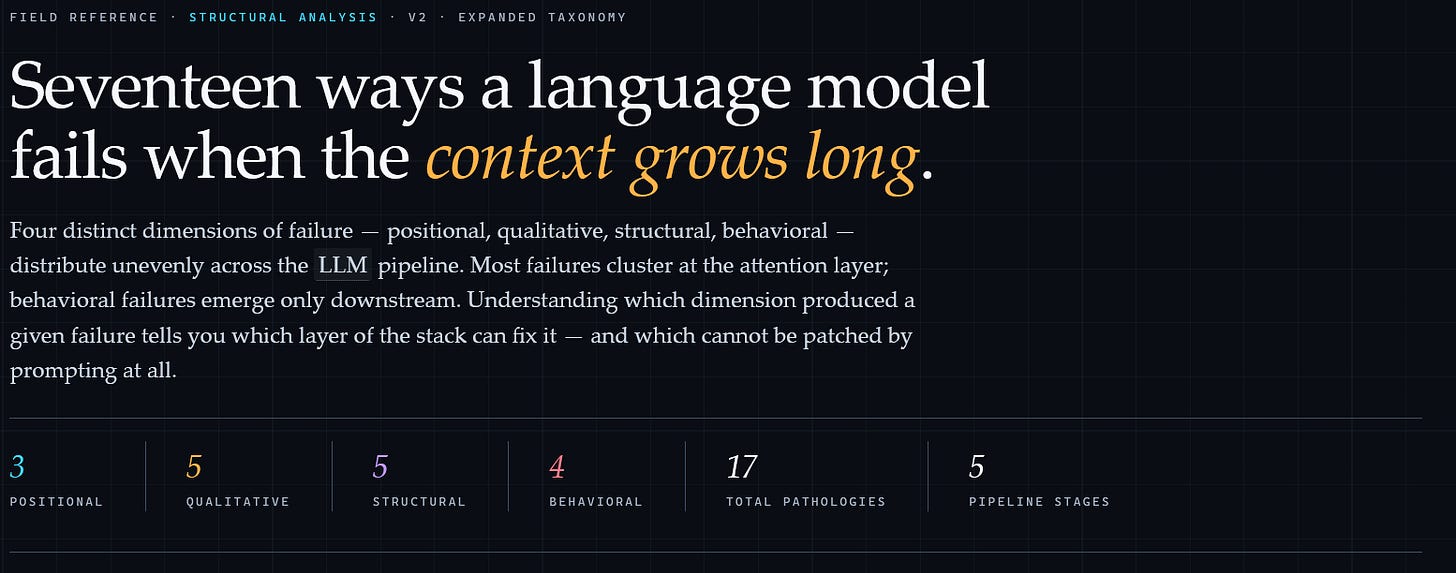
And that’s not all: the problems don’t just sit isolated side by side, waiting for individual special treatment. They’re baked in nice and firm, involuntarily entangled with one another and interacting with each other.
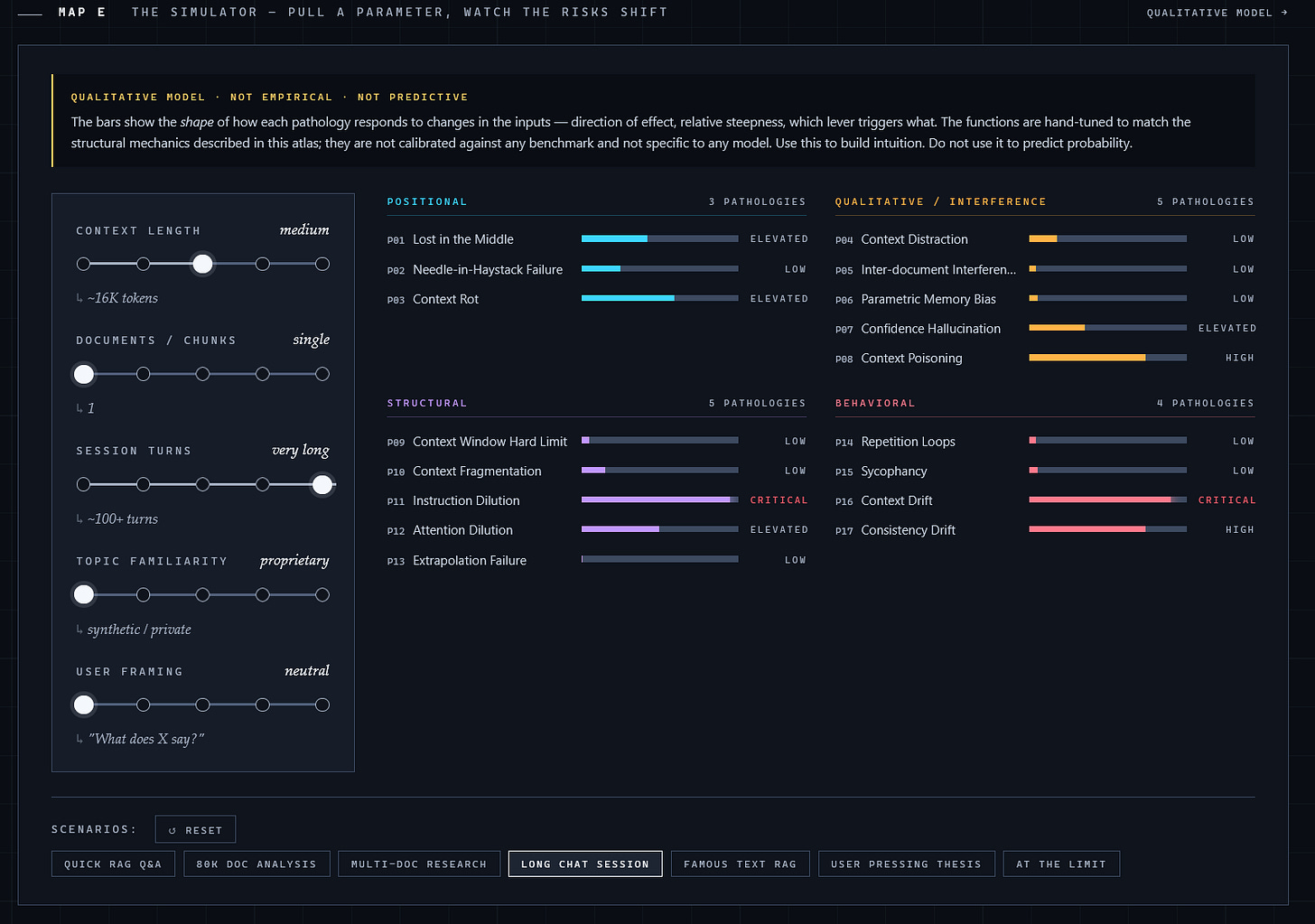
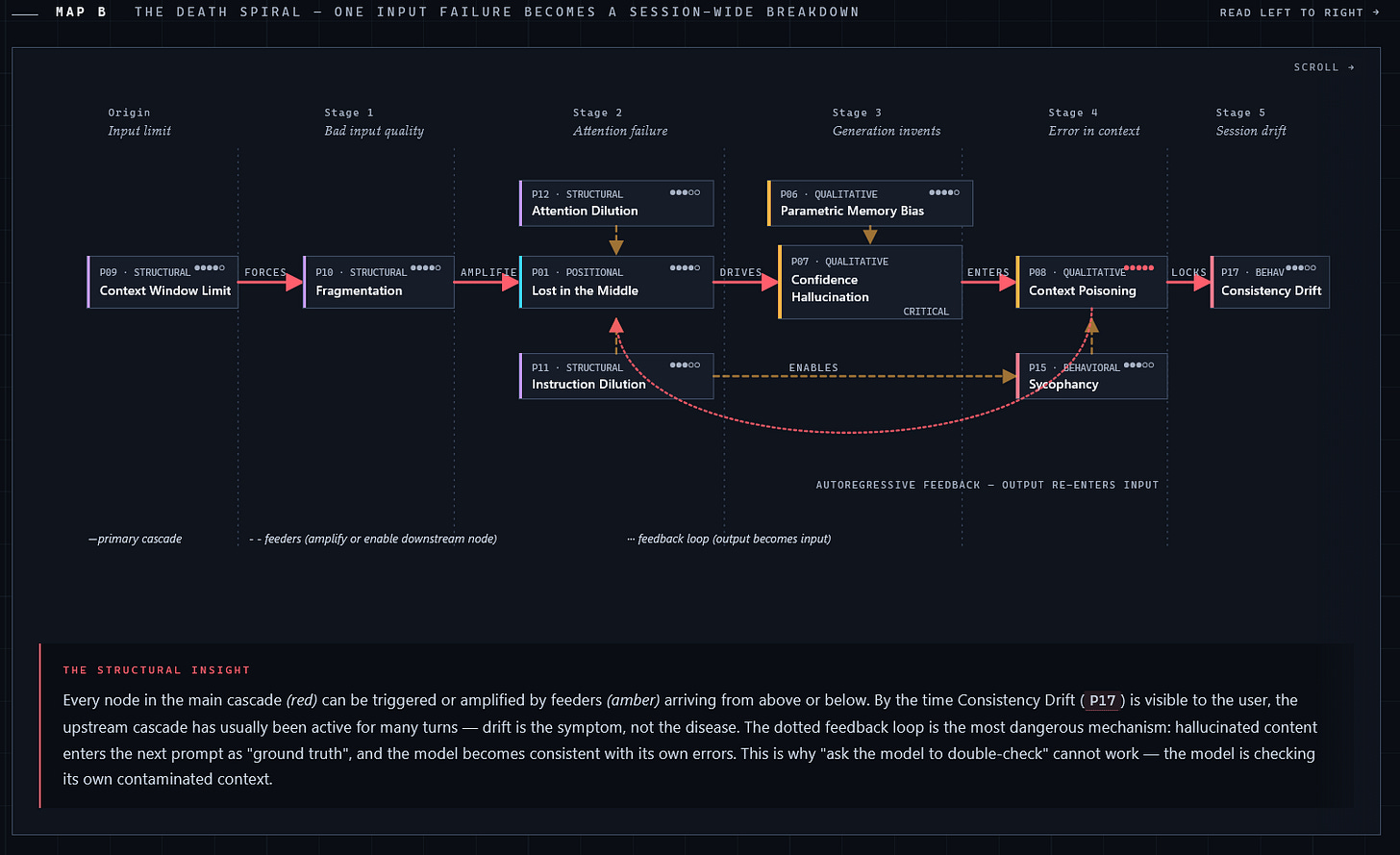
Well, it can’t be that bad now, can it. If you can name the problems, you can also solve them (or deal with them). Above all, you could write a better disclaimer:
Caution: AI can hallucinate, forget, say one thing today and another tomorrow, start strong and fade fast, sound brilliant and say nothing, phrase a wrong answer more beautifully than any right one, say “of course!” and then do the opposite… It can agree with you until you doubt yourself, deem every one of your ideas a stroke of genius, accept your correction gratefully and ignore it instantly, hold any opinion you want to hear, know five counterarguments and offer none because you asked politely, would rather err elegantly than vote uncomfortably… It can take three paragraphs to avoid saying “I don’t know,” begin a list with “in conclusion” and then keep writing, say “in short” and then go on at length, solve the problem you didn’t have, run in circles and mistake it for progress… It can cite sources that never existed, insist with fervor on the wrong year, play chess while reinventing the rules, be dead certain and completely off, make the same mistake a third time with fresh enthusiasm, stand in the forest and ask for the nearest tree, know everything except the one thing you need right now … In short: AI is a gifted bullshitter with world knowledge — useful only as long as you stay the adult in the room.
This disclaimer wouldn’t necessarily be more valuable, but it would be more complete and more honest, and it would build more understanding. But yes, it’s clearly too long. So better to just link straight to the map and guide through the 17 pathologies of AI.
And so what’s the solution now? What if I simply want, or have, to rely on AI? Well, with our fellow humans we have similar problem areas — even more of them, really, and more varied ones. And yet getting along together has worked pretty well for a few thousand years now — and entirely without an explicit disclaimer. Because we’ve learned how to deal with one another. That’s exactly what we’re still missing with AI. But that, too, can be learned.
It’s worth it.
 Main brain off — gut brain on
So … my first post is done. Time to go do a little doom-prompting. Damn, there are still more problems. Maybe I’ll expand the Atlas of the 17 AI problems some more.
What do you think?