
The Mother of All Prompts
A prompt that generates prompts. A meta-prompt. Long, ugly, twisted ... but it works.
Original on Substack ↗ Read here; like, comment and subscribe there.
The hardest thing about the AIM-TO Meta-Prompt is that the word meta is in it, because the method is dead simple: Copy – write in your own words like you normally would – copy That’s it. The end. Works. Try it out. If you want to know more, read on.
The AIM-TO Meta-Prompt is a little monster. I myself haven’t read it in many moons, and even at the very start I only ever read it top to bottom once. It isn’t meant to be pretty or easy to understand. It’s only meant to work. Which in this case means: taking unpolished, plain words, thoughts, the way you talk, notes … and packing them into a structured pattern that a machine can handle better.
Structure in this case means AIM-TO – a pattern that’s proven and that works. The simplest way to structure an instruction for the AI. OK, that was laying it on a bit thick. One possible simple way.
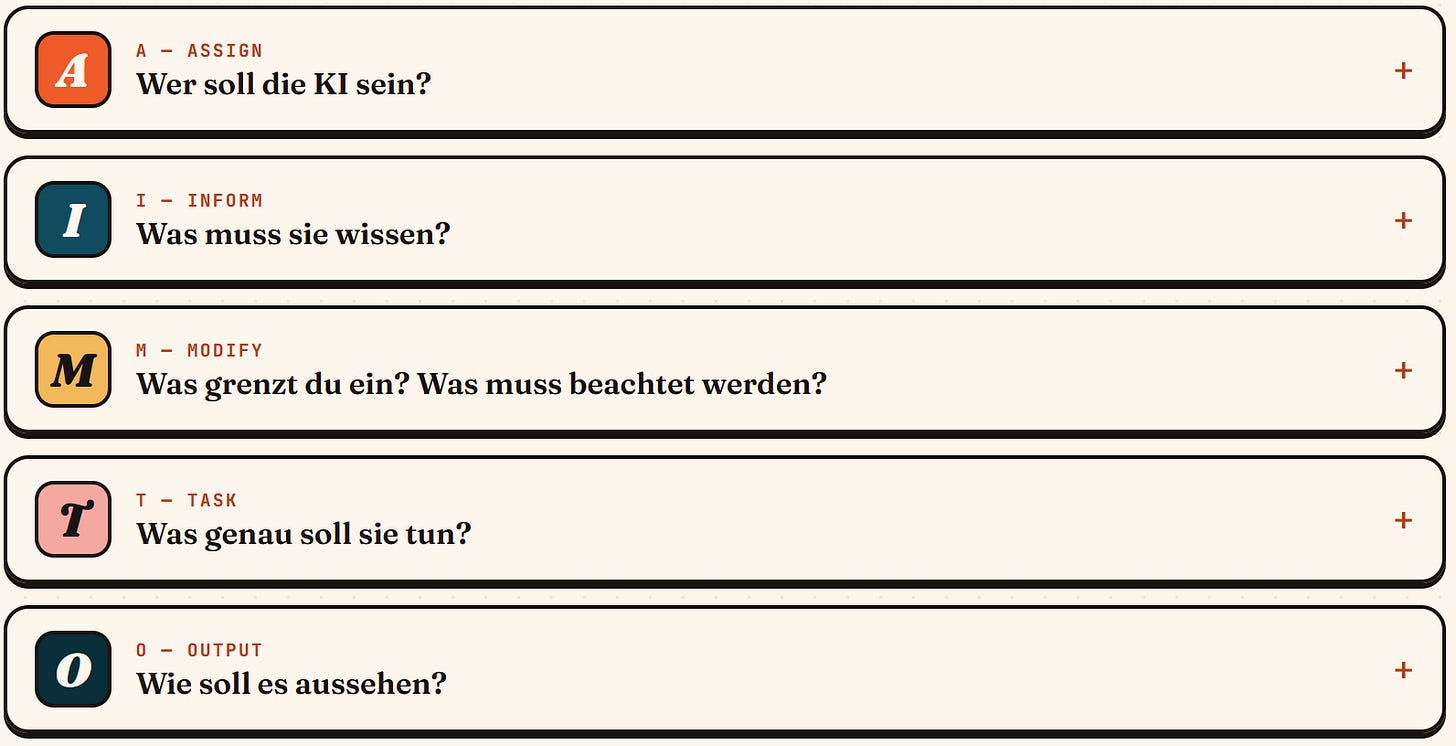
And this is no sleight of hand. I didn’t lure you into a trap just to make you cram some weird prompt pattern that you’re then supposed to stick to with great effort. I mention AIM-TO the way I’d mention the old VW bus we drive on vacation on a shared trip to Italy. But cars bore me. What matters isn’t the means of transport, it’s the vacation, the journey, the destination, the result. The vehicle is part of it, but it’s not the essential part. Our vehicle is called AIM-TO. It’s an acronym. Just an acronym. A world-class acronym, sure, but ultimately just one more mnemonic — which in this case you specifically do not(!) need to remember. It works just fine without the background knowledge. You’re sitting in the VW bus and you yourself are the most important part of your journey, not the VW bus. And I’ll stress it again, slowly and in detail and yet briefly, because it is brief. If you want to write a prompt that goes beyond a trivial request like “Explain to me why it gets dark at night” or “Fix all the typos in this email,” or if the results of your attempts so far have been rather mixed, or if you want to craft a prompt you intend to use more than just once … then you should give the AIM-TO Meta-Prompt a shot:
- Copy the AIM-TO Meta-Prompt into the AI tool of your choice – if you have several models to pick from, take the better one.
- Chat in your own words and with your own thinking. Just say what it’s about. Concrete and complete, but not contrived or stilted. Example input:
Gotta make a status deck for the project for my boss and his boss too - so something bigger, should land hard, but not water anything down either. You know, like always, everything green and one little thing red. Wanna look good and be armed in case any nasty questions come up. Here's the project info ...delivers
Generated prompt:
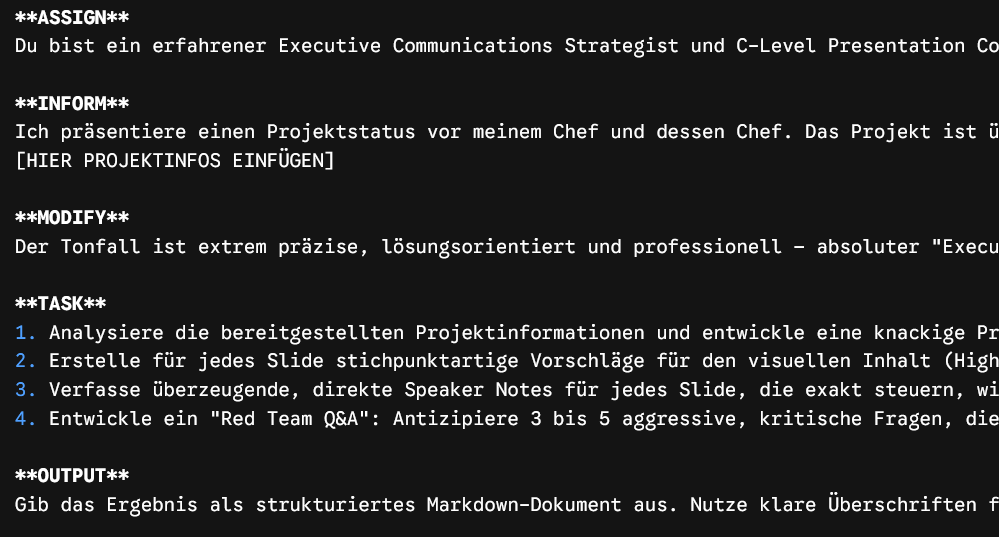
Note: You don’t have to read the generated prompt … but you do have to read the chat around it. That’s where the essentials are summed up — the gaps and the assumptions that were made:
I strictly limited the output to a 5-slide executive structure to hit the C-level focus, and built in a dedicated "Red Team Q&A" section so that on the "red" topic you keep both the narrative control and the air of having the solution. I placed the placeholder for your raw data in the INFORM part so the prompt is ready to fire the moment you paste it in.
- Copy the generated prompt — after any tweaks via chat — into a fresh chat window and use it as if you’d written it that brilliantly yourself from the start. You don’t need to read it for that! Only the result coming out of this prompt decides whether it’s good or bad.
And that’s all there is to it. The whole thing is also available in Erklärbär mode.
A few clarifying words on expectations. This whole procedure still doesn’t turn the AI into a mind reader, and the results aren’t automatically worlds better than with normal, honest, good free-text prompts. Just deliver all the relevant content for the best results. Feel free to include a touch too much information, plus prose and opinion and mood — better than too little. The ballast gets filtered out. The essence stays.
The end result won’t be a quantum leap in quality either. It makes neither the AI nor you any better. But you have to strain less to get better results, and you still end up with a super-prompt. Your super-prompt. And for that you don’t have to install any extra tool or dig up the great prompt generator again or memorize anything. There’s no behind-the-scenes action. It happens before your eyes. You carry the meta-prompt with you. Wherever you want. Everywhere. It’s only a bit of text, after all. And it builds with you, through you, and for you.
But you only wanted the internationally recognized prompt diploma anyway. Am I right? A certificate of attendance for your employer, or proof of training. Did you try the method? Does it work? Then say “Yes” out loud and download your certificate.
Good work. Congratulations.
 Main brain off — gut brain on
Mission accomplished. Now everyone’s got the meta-prompt. No more excuses. From here on out, everyone builds their own world-champion prompts. That was easy. So now I can kick off a new project. So, copy the meta-prompt – “Project briefing for a generator that builds me websites that are like PowerPoint, only cooler and better and just not Microsoft, they should be able to run anywhere. So that the deck gets generated for me when I say what I want in it. Complete. Should blow you away and rock.” … and off we go … And yes, that’s how I write my prompts. Even worse, actually, and with countless typos. The only problem I have now is properly managing all the reusable prompts I’m churning out by the conveyor-belt-load. But I’ll think of something for that too.