
Imagine it's AI and nobody can prompt
You don't have to be good at prompting to prompt well
Original on Substack ↗ Read here; like, comment and subscribe there.
AI is catapulting the unfathomable sci-fi artifacts of my childhood into touchable reality: Babel-fish-style earbuds, autonomous robots and all-knowing talking computer oracles are already everyday standard. And still, mass adoption of AI is lagging behind.
Sure, everyone has heard about AI, and nobody can avoid it anyway. But even when these powerful AI tools are served up for free on a silver platter, even with advertising and encouragement to match, actual usage is rather disappointingly low compared to the potential.
There’s still far too large a slice of fellow humans and colleagues who do nothing with AI, or wouldn’t know where to start.
The reasons are manifold:
- privacy concerns
- restricted access
- unclear legal rules around authorship and liability
- no discernible benefit
- too high an initial effort
- fear of contact
- bad first experiences
- wrong expectations
- too many mistakes
- general skepticism
- structural rejection
- …
All of these reasons are valid in the sense of understandable, but also refutable, or at least debatable. Above all, though, they shouldn’t be the thing that makes you stop — or never even start — engaging seriously with AI. And that it’s worth it, I know, and so does anyone who’s spent a little more time with AI. Whether fundamentally skeptical or positive, everyone should experience direct contact with an AI for real and unfiltered, not just consume it secondhand.
And the easiest way into communicating with AI is the prompt … that is, the words you choose to chat with the AI.
Because surely AI can talk and understand like a human, right?!
In principle, yes — but not quite, and AI’s first big promise is quickly disenchanted. AI understands more like an alien who has learned our language perfectly but doesn’t share our perception and doesn’t live inside our social fabric. An extraterrestrial who doesn’t know what important and funny really mean and can’t read between the lines. And who, on top of that, comes with not exactly few genetic defects that make it hallucinate, lie, and forget. Even though AI is a product of IT, it behaves completely differently and has to be treated completely differently than the familiar forms and tools. Those have their shortcomings and cryptic error messages too, but those we’re already used to.
And that really is paradoxical. The supposed holy grail of usability — genuine interaction in natural language — does work, but differently than expected and from what we’re used to. Because AI makes mistakes without explicit error messages. Because it needs context to work well, but doesn’t ask for it.
Because real understanding is, after all, more than just the exchange of correctly strung-together words.
Or why else would “Optimize the email to my boss” produce some rather arbitrary, sanitized, impersonal, or over-the-top polite thing. Something that isn’t factually wrong and yet feels wrong.
All the experienced prompters and AI pros cry out. Yes, of course, you have to define the role. That can’t possibly work without defining the context exactly.
And they’re right. But not everyone immediately feels encouraged to inhale all the countless aids, explanations, prompt patterns and master prompts, instructions, hints, tips and tricks, videos, trainings, just to finally get sensible results out of this box. The opposite is more like it.
And not everyone wants to, or can, search out and find their own way in through this impenetrable thicket of information.
Especially not those who already feel left behind and resign themselves, or simply have no time or desire to learn this weird new prompt-pseudo-programming-language.
The people who don’t want to think like a machine just to use a machine.
And that’s exactly the bridge AI can build. Could. Should be able to have to.
Aren’t the solutions on offer low-threshold enough? All those guides and instructions just have to get into people’s heads. It’s not that hard, is it! Stop making such a fuss.
Yes, so easy to put into practice and yet not put into practice. Maybe I’m too impatient. Change just takes time.
To cut to the chase, I went ahead and cast the silver platter into a silver bullet that solves everything. Well, at least I have one more suggestion, a variation. An even simpler approach. Very concrete. Worked out, optimized, and battle-tested. One that doesn’t tie your brain in knots and doesn’t make you reword your instruction strangely so it fits the AI. As long as you go along with the let-me-just-try-it-like-this game, it’s child’s play.
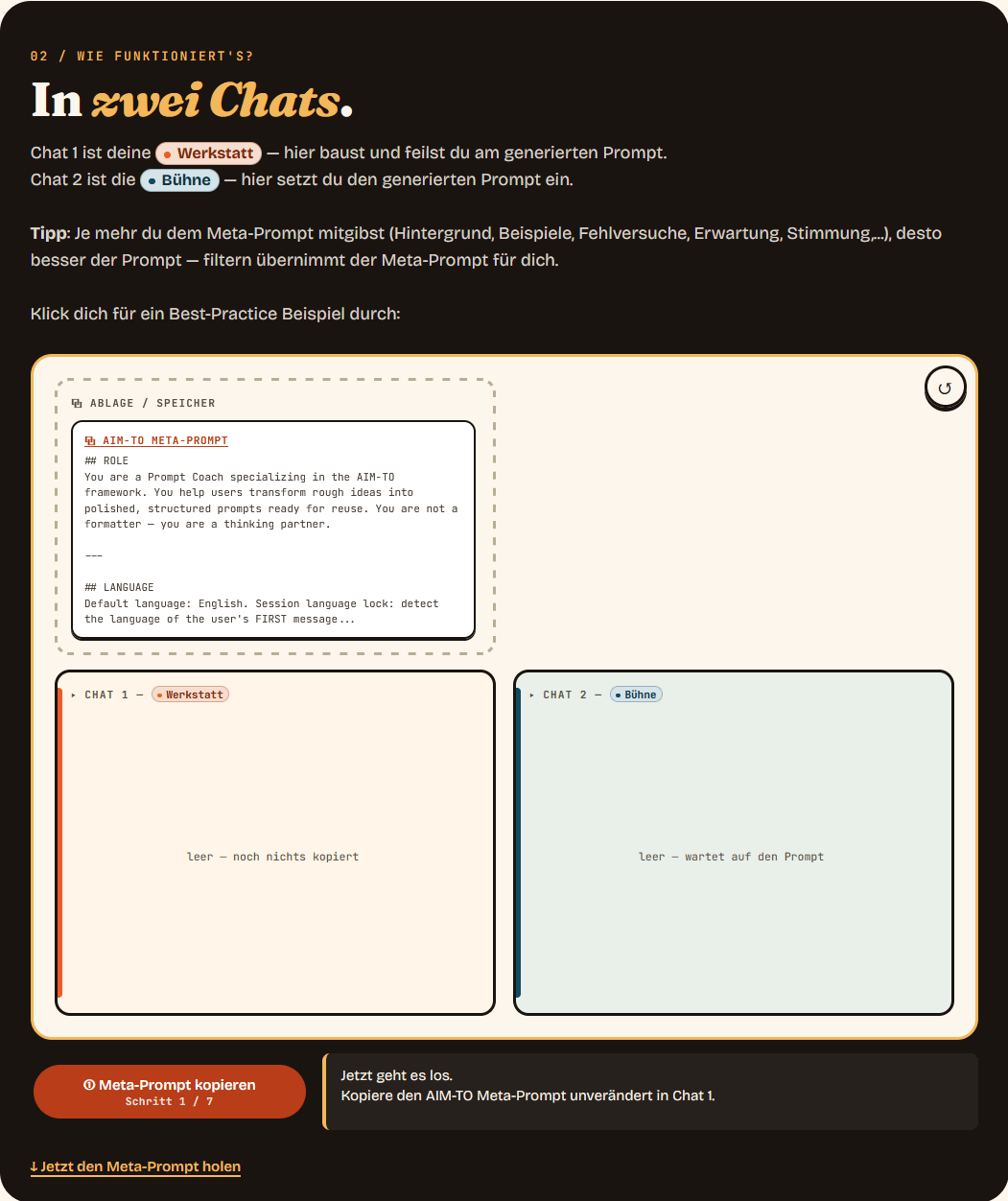
Will this close the gap and get everyone to prompt well? Probably not. But maybe I’ll reach a few for whom this exact entry point is the right one, and give a few others a leg up to the next stage on their way.
Because one thing is crystal clear.
Everyone will have to grapple with AI. Privately, professionally, as a society. So everyone should form their own picture too. A real picture, made with your own hands. Not an AI-generated one.
And my promise here and now: I’ll make everyone who reads the next post into a prompt engineer. No joke. With a certificate and the whole nine yards. Quality prompter in 10 minutes max, and without having to compulsively learn anything. Just plow through three steps, learn no rules, no prior knowledge required except being-able-to-copy.
If that’s not a good moment to subscribe, then I don’t know what is.
 Main brain off — gut brain on
Oh, enough of this keeping-you-on-tenterhooks. The next post is almost done. The certificates are fresh off the press. Done, everything’s here. Here we go. Read on … first thing tomorrow 😜.